
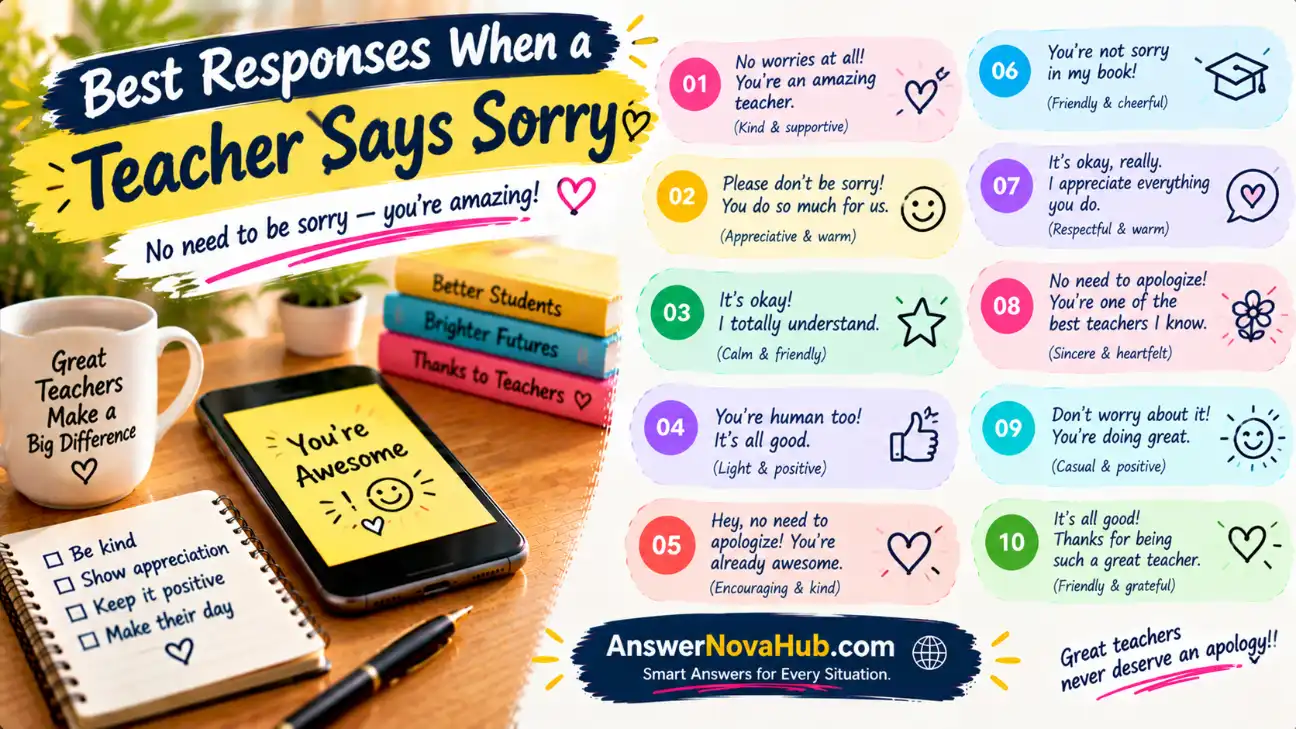
Knowing what to say when a teacher apologizes can sometimes feel awkward. You may want to be respectful without making the conversation sound overly formal or uncomfortable. The right response depends on why your teacher is apologizing, your relationship with them, and the situation.
If your teacher says sorry for being late, correcting something incorrectly, missing a class, or being too strict, a simple and polite response is usually enough. You do not need an elaborate answer.
Here are some of the best responses when a teacher says sorry, including respectful, friendly, casual, and slightly humorous options.
When a teacher says sorry, a polite response could be “No worries, it’s completely okay,” “That’s alright, no problem,” or “You don’t need to apologize.” If the situation was serious, you can acknowledge the apology directly with “Thank you for saying that. I appreciate it.”
Best Responses When a Teacher Says Sorry
Here are natural replies you can use depending on the situation:
- No worries, it’s completely okay.
- That’s alright, no problem.
- You don’t need to apologize.
- It’s perfectly fine, teacher.
- No problem at all.
- That’s okay. I understand.
- Please don’t worry about it.
- It’s all good.
- No need to say sorry.
- I understand. These things happen.
- It’s totally okay, I appreciate you saying that.
- Don’t worry, we’re good.
- It’s fine, thank you for explaining.
- I understand, no hard feelings.
- That’s okay. Thanks for apologizing.
- No problem, I understand what happened.
- You’re absolutely fine.
- It’s okay, teacher. No worries.
- I appreciate the apology, thank you.
- Everything is okay.
The safest response in most classroom situations is “No worries, I understand.” It is respectful, short, and does not make the conversation unnecessarily complicated.
Respectful Responses When a Teacher Says Sorry
If you want your reply to sound polite and mature, try one of these:
- “That’s completely okay. Thank you for apologizing.”
- “I understand, and I appreciate you saying sorry.”
- “No problem, teacher. I understand.”
- “It’s alright. Please don’t worry about it.”
- “Thank you for explaining. I understand.”
- “That’s okay. I appreciate your honesty.”
- “No worries. I understand the situation.”
- “It’s perfectly fine. Thank you for letting me know.”
- “I understand. There’s no need to worry.”
- “That’s alright. Thank you for addressing it.”
These work particularly well when your teacher is apologizing for something that genuinely affected you.
A particularly mature response
“Thank you for apologizing. I appreciate you acknowledging it.”
This response recognizes the apology without being overly casual.
Short and Simple Responses
Sometimes the best answer is the simplest one.
If your teacher says sorry during class, you can say:
- “It’s okay.”
- “No worries.”
- “That’s alright.”
- “No problem.”
- “All good.”
- “I understand.”
- “It’s fine.”
- “Don’t worry about it.”
- “Absolutely no problem.”
- “You’re good.”
A short response is especially useful when the apology is about something minor, such as a small delay or misunderstanding.
Friendly Responses When a Teacher Says Sorry
If your classroom environment is relaxed, you can respond in a warmer way:
- “No worries at all!”
- “You’re totally fine!”
- “It’s all good, don’t worry.”
- “No problem, we understand.”
- “It happens to everyone.”
- “Nothing to worry about.”
- “We’re good!”
- “No stress, teacher.”
- “It’s absolutely fine.”
- “Don’t give it another thought.”
Keep the tone friendly without becoming too familiar. Your teacher is still your teacher, so a little respect goes a long way.
<a id=”late”></a>
What to Say When a Teacher Apologizes for Being Late
Teachers can occasionally arrive late because of meetings, unexpected problems, or other responsibilities.
If your teacher says, “Sorry I’m late,” you could say:
- “No worries, teacher.”
- “That’s okay. We understand.”
- “It’s alright, no problem.”
- “Don’t worry about it.”
- “No problem. We were just waiting.”
- “That’s completely fine.”
- “It happens. No worries.”
- “You’re okay, teacher.”
If the teacher explains why they were late, you can simply respond:
“I understand. Thanks for letting us know.”
That sounds polite without making the situation awkward.
What to Say When a Teacher Apologizes for Making a Mistake
Suppose a teacher realizes they gave the wrong information or marked something incorrectly and says sorry.
A thoughtful response could be:
- “No worries. Thanks for correcting it.”
- “That’s okay. Everyone makes mistakes.”
- “I appreciate you checking it.”
- “No problem. Thanks for clearing that up.”
- “It’s alright. I understand.”
- “Thank you for correcting the mistake.”
- “No worries. We appreciate the clarification.”
- “That’s completely fine. Thanks for letting us know.”
A useful rule is to focus on the correction rather than repeatedly discussing the mistake.
Responses When a Teacher Says Sorry for Being Strict
Sometimes a teacher may realize that they were too strict and apologize.
You might respond:
- “It’s okay. I understand you were trying to help.”
- “No worries. I understand your point.”
- “That’s alright. I know you mean well.”
- “It’s fine. I appreciate you explaining.”
- “No hard feelings.”
- “I understand. We’re good.”
- “Thank you for saying that. I appreciate it.”
If the situation genuinely upset you, you do not have to pretend everything is fine. A respectful response can still acknowledge your feelings:
“Thank you for apologizing. I appreciate you understanding how I felt.”
That keeps the conversation calm and honest.
Funny or Lighthearted Responses
A little humor can work when the situation is clearly minor and your teacher has a relaxed sense of humor.
Try:
- “Apology accepted, teacher!”
- “All good—we’ll survive!”
- “No worries, lesson continues!”
- “You’re officially forgiven.”
- “No problem. Your apology has been accepted.”
- “It’s okay, teacher. We won’t put it in the class notes.”
- “Don’t worry, your secret is safe with us.”
- “All forgiven!”
Use these carefully. Humor that works with a friendly teacher might sound disrespectful in a more formal classroom.
Responses for Text Messages
If your teacher apologizes through a message, you can keep your reply polite and concise:
- “No worries, teacher. I completely understand.”
- “That’s okay. Thank you for letting me know.”
- “No problem at all. I understand.”
- “It’s completely fine. Thanks for explaining.”
- “No worries! I appreciate you letting me know.”
- “That’s alright. Thank you for apologizing.”
For a formal school-related conversation, avoid slang such as “LOL,” “whatever,” or “you’re good bro.”
How to Choose the Right Response
The best response depends on what the teacher is apologizing for.
| Situation | Suitable response |
|---|---|
| Teacher is slightly late | “No worries, teacher.” |
| Teacher made a small mistake | “That’s okay. Thanks for correcting it.” |
| Teacher missed something | “No problem. I understand.” |
| Teacher was too strict | “I understand. Thank you for apologizing.” |
| Teacher misunderstood you | “It’s okay. Thanks for clearing that up.” |
| Teacher cancels something | “No worries. Thanks for letting us know.” |
| Serious misunderstanding | “Thank you for apologizing. I appreciate it.” |
| Casual classroom situation | “It’s all good!” |
When should you be more formal?
Use a more formal response when:
- the apology concerns a serious issue;
- the conversation is taking place through official school communication;
- the teacher is discussing your grades;
- the teacher is addressing a misunderstanding;
- other staff members or parents are involved.
A simple “Thank you for apologizing. I appreciate it” is difficult to go wrong with.
What Not to Say When a Teacher Says Sorry
Even when you are joking, some responses can come across as disrespectful.
Avoid replies such as:
- “You should be sorry.”
- “About time you apologized.”
- “Whatever.”
- “I knew you were wrong.”
- “Obviously.”
- “You always do this.”
- “Finally!”
These responses can turn a small situation into an unnecessary argument.
If you disagree with your teacher, you can still explain your position respectfully.
For example:
“I appreciate the apology. I was a little confused by what happened, though.”
That opens the door to a constructive conversation.
Common Mistakes Students Make
1. Overthinking a simple apology
You usually do not need a long response. “No worries, I understand” may be enough.
2. Making the teacher feel embarrassed
If the apology is about a harmless mistake, repeatedly pointing it out can make the situation uncomfortable.
3. Using too much slang
A phrase that sounds funny among friends may sound disrespectful when directed toward a teacher.
4. Joking at the wrong time
Humor depends heavily on context. If the apology concerns something serious, choose a sincere response instead.
5. Pretending everything is fine when it isn’t
You can accept an apology while still explaining how the situation affected you.
Best Practices for Responding to a Teacher
A good response usually has three qualities:
Be respectful
Your teacher is still in a position of authority, so choose language that fits the classroom relationship.
Match the seriousness
A small mistake needs a small response. A serious misunderstanding deserves more thoughtful communication.
Keep it natural
You don’t need to sound like you’re writing a formal letter. A simple, genuine response often works best.
Listen before responding
Sometimes the teacher’s explanation gives you important context. Let them finish before deciding what to say.
Accept the apology when appropriate
If you genuinely feel comfortable accepting it, saying so can help move the conversation forward.
30 Quick Responses to a Teacher’s Apology
If you just need a quick list, here are 30 options:
- No worries, teacher.
- That’s okay.
- No problem at all.
- It’s completely fine.
- I understand.
- Don’t worry about it.
- That’s alright.
- It’s all good.
- No need to apologize.
- You’re absolutely fine.
- I appreciate the apology.
- Thanks for explaining.
- Thanks for saying that.
- No hard feelings.
- Everything is okay.
- I understand what happened.
- No stress.
- You’re good.
- It happens.
- Please don’t worry.
- That’s perfectly okay.
- I appreciate you letting me know.
- Thanks for clearing that up.
- No worries at all.
- We’re good.
- I completely understand.
- It’s fine, teacher.
- Thanks for apologizing.
- No problem, I understand.
- Everything’s fine now.
FAQs:
<a id=”faqs”></a>
What is the best response when a teacher says sorry?
A simple “No worries, I understand” is one of the safest responses. If the teacher is apologizing about something more serious, you can say, “Thank you for apologizing. I appreciate it.” The right response depends on the situation, but being respectful and sincere is usually more important than finding a clever phrase.
How do you politely respond to a teacher’s apology?
You can say, “That’s completely okay. Thank you for apologizing.” Other polite options include “I understand,” “No problem, teacher,” and “I appreciate you explaining.” These responses acknowledge the teacher’s apology without making the conversation unnecessarily formal or awkward.
What should I say if my teacher says sorry for being late?
You can simply say, “No worries, teacher,” or “That’s okay. We understand.” If the teacher explains the reason for being late, “I understand. Thanks for letting us know” is a polite response. There is usually no need to make a big issue out of a short delay.
How do I respond if a teacher apologizes for a mistake?
A helpful response is “No worries. Thanks for correcting it.” You could also say, “That’s okay. Everyone makes mistakes,” or “I appreciate you clearing that up.” These replies recognize the apology while keeping attention on resolving the mistake.
Can I make a joke when my teacher says sorry?
You can use light humor if your teacher normally jokes with students and the situation is minor. For example, “Apology accepted!” can work in a relaxed classroom. Avoid joking when the apology involves a serious problem, someone being upset, grades, discipline, or another sensitive matter.
What if I am still upset after my teacher apologizes?
You do not have to pretend that everything is fine. You can respectfully say, “Thank you for apologizing. I appreciate it, but I’m still a little upset about what happened.” This acknowledges the apology while honestly explaining how you feel.
Should I say “It’s okay” when my teacher apologizes?
Yes, if you genuinely feel that way. “It’s okay” is short and polite for minor situations. If the issue was more significant, “Thank you for apologizing. I appreciate it” may communicate your response more clearly.
What is a respectful response to a teacher over text?
Try “No worries, teacher. I completely understand. Thank you for letting me know.” For formal school communication, keep your message clear and polite. Avoid excessive slang, emojis, or jokes unless you already have a casual communication style with that teacher.
Conclusion:
The best responses when a teacher says sorry are usually simple, respectful, and appropriate for the situation. For a minor issue, “No worries, teacher” or “That’s okay” is enough. For a more serious apology, “Thank you for apologizing. I appreciate it” sounds thoughtful and mature.
The key is not to search for the most impressive response.
Choose one that matches the situation, your relationship with the teacher, and how you genuinely feel.
Whether your teacher is apologizing for being late, making a mistake, being too strict, or misunderstanding something, a calm and respectful reply can keep the conversation positive.

I’m Alexander Hayes, and I enjoy helping people communicate with confidence by finding the right response for every situation. I create well-researched, practical, and easy-to-follow reply guides that make conversations more natural and meaningful. My goal is to provide reliable advice and thoughtful responses that readers can use with confidence every day.