
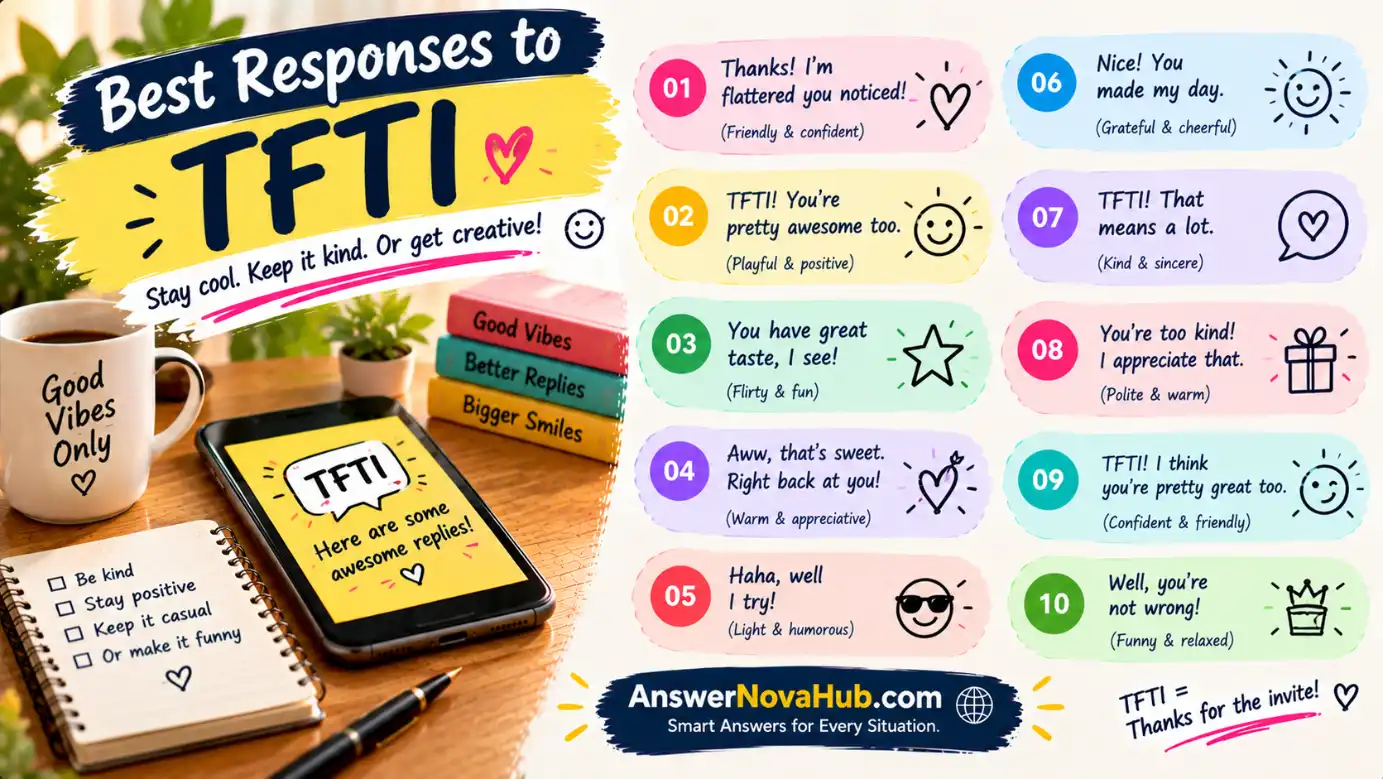
If someone texts you “TFTI”, they usually mean “Thanks for the Invite.” But the tone can vary. It might be playful sarcasm because they noticed they were left out, or it could be a genuine response to an invitation.
In some contexts, TFTI can also mean “Thanks for the Information.”
The best response depends on what the person means and how close you are.
A funny reply can keep the conversation light, while a sincere response is better if they actually feel excluded.
What Does TFTI Mean?
TFTI is a casual texting abbreviation that most commonly stands for “Thanks for the Invite.” It is frequently used when someone notices that other people made plans without including them.
For example:
Friend: “We all went out for pizza last night.”
You: “TFTI 😂”
In this situation, the message is probably sarcastic. The person is jokingly saying, “Thanks for inviting me,” even though they were never invited.
TFTI can also be sincere when someone actually receives an invitation:
Friend: “We’re having dinner Saturday. Want to come?”
You: “TFTI! I’d love to.”
Context is what makes the intended meaning clear.
Best Responses to TFTI
The right reply depends on whether the person is joking, genuinely upset, or simply thanking you. Here are some versatile responses that work in casual conversations.
- “You’re welcome. Your invitation is officially in the mail.”
- “Hey, I was saving you a spot!”
- “Next time, you’re getting VIP treatment.”
- “Oops, busted!”
- “You know you’re always invited.”
- “I thought you were busy!”
- “Consider this your official invitation.”
- “My bad! You should’ve been there.”
- “We definitely owe you one.”
- “Next adventure, you’re coming with us.”
- “Don’t worry, we’ll make it up to you.”
- “You caught us 😂”
- “I knew you’d notice!”
- “Okay, okay, we’ll invite you next time.”
- “Your invitation must have gotten lost somewhere.”
Funny Responses to TFTI
If the person is clearly joking, a humorous response can match their energy.
1. “Sorry, your invitation got lost in the mail.”
This works when you want to pretend that you actually sent an invitation.
2. “We were trying to give you some peace and quiet.”
A playful excuse that turns the situation into a joke.
3. “You weren’t invited? That’s news to me.”
This is especially funny when you want to act completely innocent.
4. “Your VIP invitation is still being processed.”
This gives the conversation a dramatic, exaggerated feel.
5. “We knew you’d be too popular to show up.”
A lighthearted compliment can make the comeback more playful.
6. “You mean you actually wanted to come?”
This works well with close friends who understand your humor.
7. “The guest list had a technical difficulty.”
A deliberately ridiculous excuse can keep the exchange funny.
8. “Fine. You can come next time. 😂”
Short, confident, and playful.
Clever Responses to TFTI
Sometimes you want something witty without sounding too sarcastic.
- “Better late than never, right?”
- “I thought you’d find your way here eventually.”
- “Your invitation is under review.”
- “We were waiting for you to ask.”
- “I assumed you had better plans.”
- “Noted. I’ll put you on the priority list.”
- “You have officially made the guest list.”
- “I’ll make sure your name is highlighted next time.”
- “Lesson learned. You’re getting the first invite.”
- “Consider this a warning for next time.”
These responses are useful when you want to acknowledge the joke without turning the conversation into an argument.
Best Sarcastic Responses to TFTI
If both of you regularly joke around, you can answer with playful sarcasm.
- “You’re welcome. We try our best.”
- “Glad you finally noticed.”
- “Anytime you want to complain, we’re here.”
- “Your feedback has been received.”
- “We’ll take that under advisement.”
- “I’ll notify the invitation department.”
- “Your complaint has been forwarded to management.”
- “We’ll schedule a meeting about this.”
- “That’s going straight into the suggestion box.”
- “We’ll pretend this never happened.”
Keep these for people who understand your humor. A sarcastic response can sound dismissive if the person is genuinely upset.
Sweet Responses to TFTI
If someone actually feels left out, a warmer response is usually better.
- “I’m sorry! I honestly didn’t mean to leave you out.”
- “You should have been there. We’ll definitely invite you next time.”
- “I didn’t realize you wanted to come.”
- “My bad. I hope you know it wasn’t intentional.”
- “We missed having you there.”
- “You’re always welcome with us.”
- “Sorry about that. Let me make it up to you.”
- “I should have asked you. That’s on me.”
- “Next time, you’re absolutely coming.”
These replies show that you understand why they said TFTI rather than simply making another joke.
Flirty Responses to TFTI
If the conversation is already playful and you want a slightly teasing response, try:
- “Maybe I was waiting for you to ask me.”
- “You could’ve just said you wanted an invitation.”
- “Next time, I’ll save a spot just for you.”
- “I didn’t know you wanted to spend time with me that badly.”
- “Looks like someone missed me.”
- “Fine, you’re officially on my guest list.”
- “I’ll make sure you get the first invitation next time.”
Use these only when that style already fits the conversation.
Short Responses to TFTI
Sometimes the best reply is simple.
- “My bad 😂”
- “Oops!”
- “Fair enough!”
- “You got me.”
- “Next time!”
- “Deal!”
- “You’re invited!”
- “Don’t worry, I got you.”
- “Noted!”
- “Absolutely!”
Short replies are especially useful in group chats and quick social-media conversations.
Responses to TFTI When Someone Feels Left Out
If the person isn’t joking, don’t rely on sarcasm. Acknowledge the situation directly.
“I’m sorry, we should’ve invited you.”
This is straightforward and takes responsibility.
“I didn’t realize you’d want to come.”
This works when the exclusion was accidental.
“You’re right. I should’ve asked.”
A simple acknowledgment can prevent a minor misunderstanding from becoming a bigger issue.
“Next time, I’ll make sure you know.”
This reassures the person without making a huge promise.
“We weren’t trying to leave you out.”
Use this when you genuinely know the situation was accidental.
How to Respond to TFTI in a Group Chat
Group chats can make tone difficult to read because everyone sees the same message.
If someone says:
“TFTI 😂”
You could reply:
“Haha, you know you’re always invited!”
Or:
“Oops 😂 Next time you’re getting the first invite.”
If the person sounds genuinely annoyed, switch to a direct response:
“Sorry, we didn’t mean to leave you out. We’ll make sure you’re included next time.”
The key is to read the surrounding conversation rather than assuming every TFTI is sarcastic.
How to Tell Whether TFTI Is Sarcastic
Several clues can help you understand the tone.
| Message | Likely tone |
|---|---|
| “TFTI 😂” | Playful |
| “TFTI 😭” | Playful or mock disappointment |
| “Wow, TFTI.” | More sarcastic |
| “TFTI 🙄” | Annoyed or sarcastic |
| “TFTI! I’d love to come.” | Genuine |
| “TFTI, what time?” | Genuine |
| “TFTI. Would’ve been nice to know.” | Probably serious |
Emojis, punctuation, the situation, and your relationship with the sender can all change how TFTI sounds.
TFTI Can Also Mean “Thanks for the Information”
Although “Thanks for the Invite” is the common interpretation in social conversations, TFTI can also mean “Thanks for the Information” or “Thanks for the Info.”
For example:
Friend: “The meeting was moved to 4 PM.”
You: “TFTI!”
Here, there is no invitation involved, so “Thanks for the Information” makes more sense.
This is why context matters when deciding how to respond.
Best Responses When TFTI Means Thanks for the Information
If the person is using TFTI to mean “Thanks for the Information,” you can respond naturally:
- “You’re welcome!”
- “No problem!”
- “Anytime!”
- “Glad I could help.”
- “Of course!”
- “Just keeping you updated.”
- “Happy to help.”
- “You got it!”
- “No worries.”
- “Absolutely!”
Don’t automatically treat TFTI as sarcasm if the conversation is clearly about information rather than invitations.
Common Mistakes When Responding to TFTI
Taking Every TFTI Seriously
Sometimes TFTI is just friendly teasing. Responding with a long defensive explanation can make a harmless joke awkward.
Making the Joke Too Harsh
A sarcastic comeback can go too far if the other person genuinely feels excluded.
Ignoring the Context
Look at what happened immediately before the message. Was there a party, dinner, trip, or outing? If so, “Thanks for the Invite” is probably the intended meaning.
Using TFTI in Formal Conversations
Texting abbreviations are best suited to casual communication. If you’re responding to a professional invitation, a formal event, or someone you don’t know well, spelling out “Thanks for the invitation” is clearer.
Assuming the Meaning Is Always the Same
TFTI has more than one interpretation. “Thanks for the Information” can make sense when the conversation is about an update or useful fact.
How to Choose the Perfect TFTI Response
Use this simple approach:
If they’re joking:
Match their humor.
If they’re mildly annoyed:
Acknowledge it and keep your response friendly.
If they’re genuinely upset:
Apologize and explain briefly.
If TFTI means “Thanks for the Information”:
Simply say you’re welcome.
If you’re unsure:
Choose a neutral response such as, “Haha, you’re always invited!”
This avoids escalating the situation while keeping the conversation natural.
Best Practices for Responding to TFTI
A good TFTI response should match three things: context, relationship, and tone.
With a close friend, something funny like “Your invitation got lost in the mail 😂” can work perfectly.
With someone who sounds genuinely disappointed, “Sorry, we should’ve invited you” is much better.
And when you’re unsure what TFTI means, don’t overthink it. Look at the conversation immediately before the message. The surrounding context usually provides the answer.
FAQs:
What does TFTI mean in texting?
TFTI most commonly means “Thanks for the Invite.” In texting and social media, it is often used sarcastically when someone discovers that friends or other people made plans without inviting them. It can also be used genuinely after receiving an invitation. Another recognized interpretation is “Thanks for the Information,” so the subject of the conversation helps determine the intended meaning.
What is the best response to TFTI?
The best response depends on the tone. If someone is joking, a playful answer such as “Oops, you caught us!” can work. If they genuinely feel excluded, a sincere response such as “Sorry, we should’ve invited you” is more appropriate. When you’re unsure, a friendly neutral response like “You’re always invited!” can keep the conversation positive without assuming too much.
Is TFTI sarcastic?
TFTI is often used sarcastically, especially when someone sees that friends went somewhere or made plans without them. For example, “TFTI 😂” after seeing photos from a dinner can jokingly mean “Thanks for leaving me out.” However, TFTI isn’t always sarcastic. Someone who actually received an invitation can use it sincerely, particularly in a casual conversation.
What does TFTI mean on social media?
On social media, TFTI commonly means “Thanks for the Invite.” It is often posted as a comment when someone sees photos, stories, or posts about an event they were not invited to. The message can be playful rather than genuinely angry. Emojis such as 😂 or 😭 often make the teasing tone clearer, although the exact meaning still depends on the relationship and context.
Can TFTI mean something other than “Thanks for the Invite”?
Yes. TFTI can also mean “Thanks for the Information” or “Thanks for the Info.” This interpretation makes more sense when someone has just shared useful information rather than an invitation. For example, if someone tells you that a meeting has moved to a different time, TFTI could mean “Thanks for the Information.” Context is the easiest way to distinguish the meanings.
Is TFTI rude?
TFTI isn’t automatically rude. Between friends, it is often playful teasing. However, the same abbreviation can sound passive-aggressive if the person genuinely feels excluded or if the relationship is not very close. A plain “TFTI.” without an emoji may also sound more serious than “TFTI 😂.” When responding, consider whether the person seems to be joking or actually expressing disappointment.
What should I say if someone says TFTI because I didn’t invite them?
If you accidentally left someone out, keep the response honest and simple. Try saying, “I’m sorry, I didn’t mean to leave you out,” or “My bad, I should’ve invited you.” If the situation was clearly playful, you can add some humor afterward. Acknowledging their feelings first is usually better than immediately responding with another sarcastic joke.
Can I use TFTI when someone actually invites me?
Yes, but it can sometimes be misunderstood because TFTI is strongly associated with sarcastic comments about being left out. If you want to make your gratitude completely clear, say “Thanks for the invite!” instead. If you’re talking casually with close friends, “TFTI! I’m in” can make your intended meaning obvious.
Conclusion:
The best responses to TFTI depend on what the sender means and how they say it. When TFTI means “Thanks for the Invite,” a funny comeback can keep the conversation playful, while a sincere apology works better if the person genuinely feels left out.
Remember that TFTI can also mean “Thanks for the Information,” so always check the surrounding conversation before choosing your response.
Whether you want to be funny, clever, sweet, sarcastic, or straightforward, the safest approach is simple: match the tone, understand the context, and avoid turning a small joke into a serious argument.

I’m Alexander Hayes, and I enjoy helping people communicate with confidence by finding the right response for every situation. I create well-researched, practical, and easy-to-follow reply guides that make conversations more natural and meaningful. My goal is to provide reliable advice and thoughtful responses that readers can use with confidence every day.