
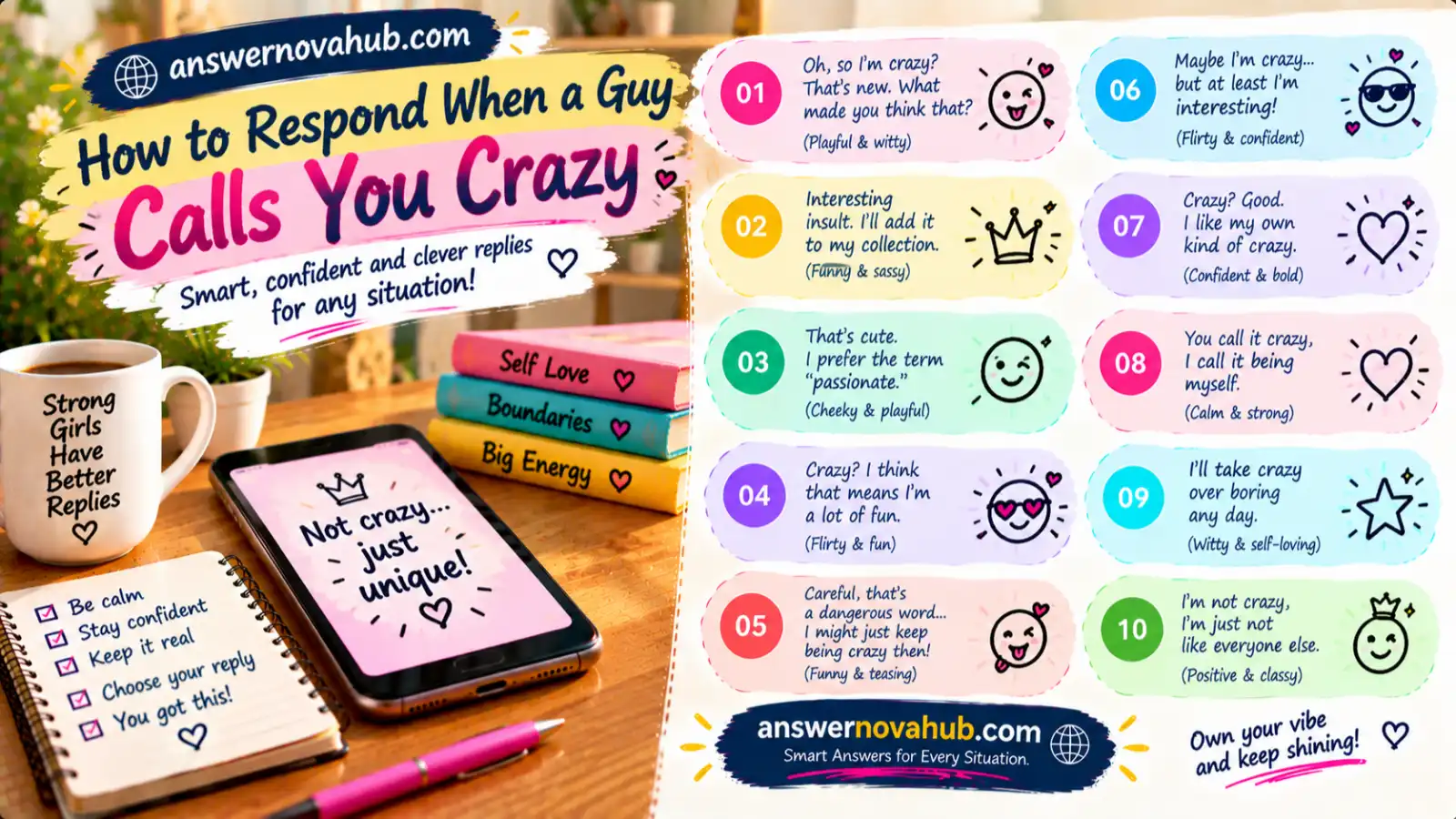
Being called “crazy” by a guy can be confusing, especially when you are not sure whether he is joking, flirting, teasing you, or genuinely criticizing you.
The best response depends on the situation, your relationship with him, and the tone behind his words.
If you’re wondering how to respond when a guy calls you crazy, you don’t have to become defensive.
You can answer with humor, confidence, sarcasm, curiosity, or a clear boundary.
Quick answer: When a guy calls you crazy, respond based on his tone and your relationship. You can say something playful like “Crazy? You haven’t seen anything yet,” confident like “I prefer unpredictable,” or direct like “What makes you say that?” If the comment feels disrespectful, calmly tell him you don’t appreciate being labeled that way.
What Does It Mean When a Guy Calls You Crazy?
The word “crazy” can mean very different things depending on the situation.
Sometimes a guy says it jokingly because you did something unexpected. Other times, he may be flirting, teasing, expressing surprise, or trying to criticize your behavior.
Consider what happened immediately before he said it.
For example:
- You made an unexpected joke → he may be teasing you.
- You challenged his opinion → he may be reacting defensively.
- You did something adventurous → he may mean “wild” or “unpredictable.”
- You became upset during an argument → he may be dismissing your feelings.
- You made a playful comment → he may be flirting.
- He repeatedly calls you crazy during disagreements → the situation deserves a more serious response.
The context matters more than the single word.
How to Respond When a Guy Calls You Crazy
If you want a confident response without making the conversation awkward, keep your reply short.
Here are some versatile options:
- “Crazy? I prefer interesting.”
- “You say that like it’s a bad thing.”
- “Only on special occasions.”
- “Maybe you’re just not used to me.”
- “What makes you think I’m crazy?”
- “I call it being unpredictable.”
- “And yet, you’re still talking to me.”
- “You haven’t seen my full potential yet.”
- “Maybe I’m just a little too much fun for you.”
- “Crazy is a strong word. Explain yourself.”
- “I prefer the term uniquely complicated.”
- “Depends who you ask.”
- “At least I’m never boring.”
- “That’s your opinion.”
- “Maybe you bring out that side of me.”
The best answer is often the one that matches the energy of the conversation rather than sounding rehearsed.
Funny Responses When a Guy Calls You Crazy
If he is clearly joking and you want to keep things light, humor can turn the comment into a fun exchange.
Try these:
- “Crazy? I thought you liked interesting people.”
- “I prefer professionally unpredictable.”
- “Don’t worry, there’s a user manual somewhere.”
- “Crazy comes with great personality.”
- “I’m not crazy. I’m creatively logical.”
- “You noticed? I was trying to hide it.”
- “That’s what makes me memorable.”
- “I blame the caffeine.”
- “Crazy? No, just highly entertaining.”
- “You say crazy, I say limited edition.”
- “I’m only crazy when I’m bored.”
- “Good. Normal sounds exhausting.”
- “And somehow you keep coming back.”
- “I have a certificate in being dramatic.”
- “That’s the nicest way anyone has described me today.”
A funny answer works especially well when the original comment was clearly playful rather than insulting.
Flirty Responses When a Guy Calls You Crazy
If you like the guy and his comment sounds playful or flirtatious, you can answer with a little confidence.
Some options include:
- “Maybe you bring out my crazy side.”
- “You seem to like it.”
- “And yet you haven’t walked away.”
- “Careful, you might start enjoying it.”
- “Maybe I’m only crazy around you.”
- “You haven’t figured me out yet.”
- “Are you complaining or flirting?”
- “You say crazy like you’re interested.”
- “Maybe you’re just my kind of trouble.”
- “If you think I’m crazy now, wait until you know me better.”
These replies keep the conversation playful without taking the exchange too seriously.
Sarcastic Responses When a Guy Calls You Crazy
Sometimes a little sarcasm is the right response, particularly when you want to show that his comment does not bother you.
Try:
- “Wow, what an original observation.”
- “Thanks for the groundbreaking analysis.”
- “I’ll add that to my list of concerns.”
- “Your professional opinion has been noted.”
- “That’s fascinating. Tell me more.”
- “I’ll try to recover from that.”
- “And here I was worried about your opinion.”
- “Congratulations, detective.”
- “You figured that out all by yourself?”
- “I’ll alert the authorities immediately.”
Sarcasm works best when both people understand that the exchange is playful. If he is genuinely being disrespectful, a direct response may be more effective.
Confident Responses When a Guy Calls You Crazy
You don’t always need to joke.
A confident response can show that you are comfortable with yourself without turning the conversation into an argument.
Consider:
- “I’m comfortable being myself.”
- “You don’t have to understand me.”
- “I’m not going to change just to seem predictable.”
- “Everyone has their own opinion.”
- “I know who I am.”
- “Different doesn’t automatically mean crazy.”
- “I’m allowed to have my own personality.”
- “You can call it crazy; I call it being myself.”
- “If something bothers you, tell me specifically.”
- “Labels don’t really explain a person.”
This approach is useful when you want to stay calm and avoid giving his comment more power than it deserves.
Best Comebacks When a Guy Calls You Crazy
If you want a clever comeback, try one of these:
- “Crazy enough to keep you interested.”
- “Maybe you’re just not ready for this personality.”
- “I’m not crazy. I’m selectively reasonable.”
- “You haven’t exactly convinced me you’re normal.”
- “Interesting accusation from you.”
- “That’s one way to describe confidence.”
- “Maybe you’re confusing confidence with crazy.”
- “I could say the same about you.”
- “At least I’m never predictable.”
- “You clearly haven’t met enough interesting people.”
A good comeback doesn’t have to be harsh. The goal is to respond confidently while keeping control of the conversation.
What to Say If He Calls You Crazy During an Argument
This situation is different.
If you’re having a serious disagreement and he dismisses your feelings by calling you “crazy,” making another joke may not solve the problem.
Instead, ask for clarity:
- “What exactly did I do that made you say that?”
- “Can we talk about the actual issue instead of labeling me?”
- “If you disagree with me, explain why.”
- “I don’t think calling me crazy helps this conversation.”
- “Let’s focus on what happened.”
- “You can disagree with me without insulting me.”
- “If something I said upset you, tell me directly.”
This shifts the conversation away from name-calling and toward the actual disagreement.
How to Respond If He Says “You’re Crazy” as a Joke
Not every “you’re crazy” comment is meant negatively.
Friends, couples, classmates, and people who are getting to know each other sometimes use “crazy” casually to describe something surprising or funny.
If his tone is clearly playful, you could say:
“Only a little.”
Or:
“That’s part of the charm.”
You can also playfully challenge him:
“Crazy how?”
That response is useful because it gives him a chance to explain what he means.
How to Respond If You Don’t Like Being Called Crazy
You are allowed to dislike the label.
You don’t need to laugh along if the comment makes you uncomfortable.
Try:
- “I don’t really like being called that.”
- “I’d rather you tell me what you actually mean.”
- “Please don’t label me like that.”
- “If you have an issue with something I did, just say it.”
- “That word doesn’t feel respectful to me.”
- “Let’s talk about the behavior instead of calling me names.”
A calm boundary can be much more effective than an aggressive comeback.
Should You Ignore a Guy Who Calls You Crazy?
Ignoring the comment can sometimes be the easiest option.
If he is obviously teasing you and you don’t care, you can simply laugh or move on.
However, repeatedly ignoring disrespectful comments can leave an important issue unresolved.
Ask yourself:
- Was he joking?
- Did he apologize if you were offended?
- Does he respect your boundaries?
- Does he use “crazy” whenever you disagree?
- Is this a one-time comment or a repeated pattern?
- Do you feel comfortable talking openly with him?
Your response should depend on the pattern, not just one sentence.
Crazy vs. Playful: How to Tell the Difference
Tone and context can completely change the meaning.
| Situation | Possible meaning | Useful response |
|---|---|---|
| He laughs after saying it | Playful teasing | “You seem to enjoy my chaos.” |
| He says it while flirting | Playful or flirtatious | “Are you flirting with me?” |
| He says it after an unexpected joke | Surprise | “You liked it, though.” |
| He says it during an argument | Dismissive criticism | “Let’s discuss the actual issue.” |
| He says it repeatedly | Possible disrespect | “I’d prefer you not label me.” |
| He immediately apologizes | He may have realized it hurt | “I appreciate that.” |
There isn’t one universal meaning behind the word.
What Not to Do When a Guy Calls You Crazy
A strong response is not necessarily the harshest one.
Avoid immediately escalating the situation with personal insults, especially if you don’t know what he meant.
You also don’t need to prove that you’re “not crazy.” That can turn a casual comment into a bigger argument.
Avoid:
- Insulting him immediately.
- Sending a long defensive explanation.
- Assuming his exact intention without asking.
- Letting one joke ruin your entire mood.
- Pretending something is funny when it genuinely bothers you.
- Repeatedly arguing about the label instead of discussing the real issue.
Sometimes the smartest response is simply:
“What do you mean by that?”
His answer may tell you much more than the original comment.
How to Choose the Right Response
Before replying, quickly consider three things: tone, relationship, and intention.
If he’s joking
Use humor.
Example: “Only a little.”
If he’s flirting
Use playful confidence.
Example: “Are you complaining or flirting?”
If you’re unsure
Ask a question.
Example: “What makes you say that?”
If he’s being disrespectful
Set a boundary.
Example: “I’d rather you explain what you mean instead of calling me crazy.”
If you’re arguing
Bring the conversation back to the issue.
Example: “Let’s talk about what actually happened.”
This simple approach prevents you from overreacting to a comment that may have had a completely different meaning.
Short Responses to “You’re Crazy”
Sometimes you don’t need a clever paragraph.
Here are quick replies:
- “Maybe.”
- “A little.”
- “And proud of it.”
- “Only sometimes.”
- “So I’ve heard.”
- “That’s debatable.”
- “Prove it.”
- “Interesting.”
- “According to you.”
- “What makes you think that?”
- “I prefer unpredictable.”
- “You say that like it’s bad.”
- “I’m just being me.”
- “That’s your interpretation.”
- “Care to explain?”
Short answers can actually sound more confident because they don’t make the situation bigger than it needs to be.
What Does It Mean If a Guy Calls You Crazy but Keeps Talking to You?
If he calls you crazy and continues the conversation, that alone does not prove that he likes you or dislikes you.
He may simply be comfortable joking with you. He could also be trying to tease you, express surprise, or criticize something you did.
Look at the larger pattern instead.
Does he listen to you? Does he respect your boundaries? Does he communicate clearly? Does he treat you differently when other people are around?
One phrase rarely tells the whole story.
How to Respond When a Guy Says “You’re Crazy, But I Like It”
That statement is usually intended as playful teasing, but the right response depends on your feelings.
If you’re interested, you could say:
- “Then I guess we’re even.”
- “Good, because boring isn’t my thing.”
- “You might be a little crazy too.”
- “Glad we’re on the same page.”
- “Careful what you wish for.”
If you’re not interested:
- “Glad you enjoy it, but let’s keep things friendly.”
- “That’s nice, but I’m not looking for anything like that.”
Being clear is better than sending mixed signals.
Expert Tips for Giving a Good Comeback
A memorable response isn’t necessarily the most savage one.
The strongest replies usually have three qualities:
1. They match the situation.
A playful comment deserves a playful response, while a serious insult may need a boundary.
2. They stay short.
Long explanations can make a simple comment feel much more serious.
3. They protect your confidence.
You don’t need to prove your worth because someone used a label.
A useful rule is:
Match the tone, protect your boundaries, and don’t over-explain.
FAQs:
What is the best response when a guy calls you crazy?
The best response depends on his tone. If he’s joking, try something playful such as “I prefer interesting.” If you’re unsure what he means, ask “What makes you say that?” If he is being disrespectful, calmly say, “I’d rather you tell me what you mean instead of calling me crazy.” Context matters more than having one perfect comeback.
What does it mean when a guy calls you crazy?
A guy might call you crazy because he is joking, teasing, flirting, surprised by something you did, or criticizing your behavior. The phrase does not have one fixed meaning. Pay attention to his tone, facial expression, the conversation around it, and whether he respects you when you tell him the comment bothers you.
How do you respond to a guy calling you crazy in a funny way?
You can answer with light humor if the situation is friendly. Try “Crazy? I prefer entertaining,” “Only on weekends,” or “That’s what makes me memorable.” Funny responses work best when you are confident that he is joking and you are comfortable continuing the playful conversation.
What should I say if a guy calls me crazy during an argument?
When someone calls you crazy during a serious argument, avoid getting distracted by the label. Ask what specific behavior or statement he disagrees with. You could say, “Let’s talk about the actual issue instead of labeling me.” This keeps the discussion focused and gives both people a chance to explain their point.
How do I respond if I don’t like being called control?
You can set a simple boundary. Say, “I don’t like being called that,” or “If something I did bothers you, please tell me directly.” You don’t have to laugh at a comment that makes you uncomfortable. A respectful person should be able to discuss the issue without relying on insulting labels.
Is calling someone control always an insult?
No. In casual conversation, people sometimes use “control” to mean funny, unpredictable, adventurous, or surprising. However, the same word can be insulting when used to dismiss someone’s feelings or during an argument. The surrounding context, tone, and relationship determine how the comment is likely to be understood.
How can I tell if he is flirting when he calls me control?
You cannot determine romantic interest from that phrase alone. Look at the broader interaction instead. Playful teasing, continued conversation, compliments, and clear interest may provide more context, but none of these signs guarantees his intentions. If you’re comfortable doing so, a direct question can remove some uncertainty.
What is a confident response to “You’re control”?
A confident response could be “Maybe, but I’m comfortable being myself,” or “I prefer unpredictable.” If you want clarification, “What makes you say that?” is even more useful. Confidence doesn’t require proving that the other person is wrong; it can simply mean responding calmly and deciding whether the comment deserves your attention.
Conclusion:
Knowing how to respond when a guy calls you control starts with understanding the situation rather than searching for one perfect comeback.
If he’s joking, humor can keep things fun. If he’s flirting, a playful response can keep the conversation going. If you’re unsure, ask what he means. And if the comment feels disrespectful, you can set a clear boundary without turning the conversation into a fight.

I’m Alexander Hayes, and I enjoy helping people communicate with confidence by finding the right response for every situation. I create well-researched, practical, and easy-to-follow reply guides that make conversations more natural and meaningful. My goal is to provide reliable advice and thoughtful responses that readers can use with confidence every day.