
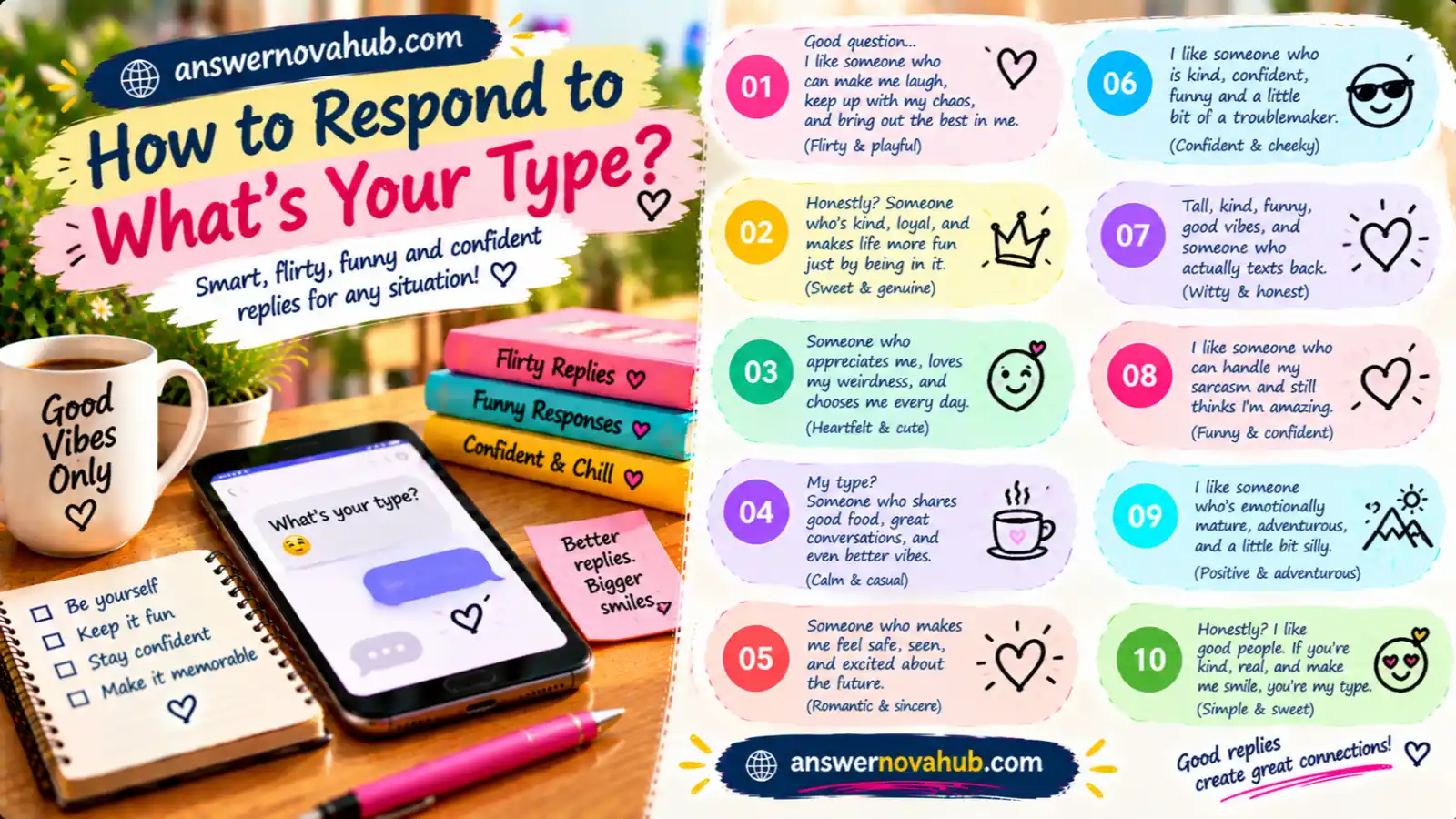
When someone asks, “What’s your type?”, they may simply be curious—or they may be trying to find out whether they fit what you like. Your answer can be serious, funny, playful, flirty, vague, or completely direct depending on who is asking and how comfortable you feel.
The best response doesn’t have to be complicated. A short, natural answer often works better than trying to describe your “perfect person” in detail.
Quick answer: The best way to respond to “What’s your type?” depends on the situation. You can describe personality traits you value, keep it playful with a joke, give a flirty answer if the conversation feels right, or stay vague if you don’t want to reveal much. Choose a response that feels natural and matches your relationship with the person asking.
What Does “What’s Your Type?” Mean?
When someone asks about your type, they usually want to know what qualities you find attractive or appealing in another person.
Your “type” can refer to many things, including:
- Personality
- Sense of humor
- Confidence
- Kindness
- Intelligence
- Shared interests
- Communication style
- Values
- Appearance
- Energy or personality
- Lifestyle
It doesn’t necessarily mean you have a strict checklist. Many people are attracted to someone who simply makes them feel comfortable, respected, and understood.
How to Respond to What’s Your Type
A good response depends on who is asking and why.
If it’s a casual conversation, you can keep your answer simple:
- “Someone kind, confident, and easy to talk to.”
- “I don’t really have a specific type. I just like good people.”
- “Someone with a great sense of humor.”
- “Someone who is genuine and knows how to communicate.”
- “Honestly, personality matters more to me than a specific look.”
If you think the person might be asking because they’re interested in you, you can make your answer slightly more personal.
For example:
- “Someone who makes me laugh and keeps me guessing.”
- “Someone confident but not arrogant.”
- “Someone who’s easy to be around.”
- “Maybe someone with your kind of personality.”
That last response is more direct, so use it when you’re comfortable with the conversation.
Best Responses to “What’s Your Type?”
If you want a confident and natural response, try one of these:
- “Someone kind, confident, and genuine.”
- “I like people who can make me laugh.”
- “Someone who communicates well and keeps things interesting.”
- “I don’t really have a type. I just know when I like someone.”
- “Someone with a good heart and a good sense of humor.”
- “Personality is a big deal for me.”
- “Someone who’s comfortable being themselves.”
- “A person who is honest, thoughtful, and fun.”
- “Someone I can have both serious and silly conversations with.”
- “I like people who make me feel comfortable being myself.”
Funny Responses to “What’s Your Type?”
Sometimes the question is better answered with humor.
Try these funny replies:
- “Someone who can survive my sense of humor.”
- “Someone who knows how to order food without taking 20 minutes.”
- “Someone who makes me laugh. Bonus points if they share snacks.”
- “My type? Currently accepting applications.”
- “Someone who doesn’t leave me on read.”
- “Someone with a good personality and excellent Wi-Fi.”
- “Someone who can match my level of weird.”
- “Someone who laughs at my jokes, even the bad ones.”
- “Someone who knows when to bring snacks.”
- “I have a type, but apparently my type has other plans.”
These work especially well when the conversation is casual and you don’t want to give a serious answer.
Flirty Responses to “What’s Your Type?”
If the conversation has a playful or romantic tone, you can make your response a little more teasing.
Try:
- “Someone who looks a little like you.”
- “Should I describe you, or would that be too obvious?”
- “I could tell you, but you might start getting confident.”
- “Someone with your energy, maybe.”
- “Why? Are you checking whether you qualify?”
- “Someone who’s currently asking me this question.”
- “Maybe I should just point at you.”
- “You might actually be my type.”
- “I think you’re asking for a reason.”
- “Do you want the honest answer or the fun answer?”
A flirty answer works best when there is already some mutual comfort. If you’re unsure about the other person’s intentions, a neutral response is safer.
Cute Responses to “What’s Your Type?”
For a sweet and friendly conversation, try something softer:
- “Someone who makes ordinary days feel fun.”
- “Someone who is kind without trying to impress everyone.”
- “Someone who makes me smile without even trying.”
- “Someone I can be completely myself around.”
- “Someone thoughtful and easygoing.”
- “Someone who remembers the little things.”
- “Someone who makes me feel appreciated.”
- “Someone who can turn a boring conversation into a good one.”
Smart and Mature Responses
If you want to sound thoughtful rather than giving a list of physical preferences, focus on character.
- “I value kindness, emotional maturity, and honesty.”
- “I don’t have a fixed type. Compatibility matters more to me.”
- “I look for someone whose values match mine.”
- “Someone who communicates openly and treats people well.”
- “I care more about how someone treats others than how they look.”
- “Someone who is confident without needing to put others down.”
- “Someone who’s curious, respectful, and comfortable with themselves.”
These answers communicate what matters to you without making the conversation overly personal.
How to Answer If You Don’t Have a Type
You don’t need to invent a type just because someone asks.
You can simply say:
- “I honestly don’t have a specific type.”
- “I’ve never really thought about it.”
- “It depends on the person.”
- “I care more about chemistry than a checklist.”
- “I don’t usually know what I like until I meet someone.”
- “My type changes depending on the person.”
- “I think connection matters more than having a type.”
This can actually make your answer more interesting because it leaves room for individuality.
How to Respond If You Think They Like You
If you suspect the person is asking because they’re interested, pay attention to the context.
A playful answer can keep the conversation going:
- “Why, are you trying to see if you qualify?”
- “Are you asking for research purposes?”
- “Is this a trick question?”
- “Why do I feel like you’re asking for a reason?”
- “Maybe you should tell me your type first.”
- “What makes you think you aren’t already my type?”
If you’re interested in them, you can be more direct. If you’re not, you can keep your response friendly without encouraging something you don’t want.
How to Respond If You Don’t Want to Reveal Your Type
You don’t owe anyone a detailed answer.
Try:
- “That’s classified information.”
- “I’m keeping that one private.”
- “I’d rather let people surprise me.”
- “I don’t really discuss my type.”
- “You’ll have to figure that out yourself.”
- “I don’t have a public list.”
- “Let’s just say I know what I like when I see it.”
A light response can help you change the subject without making the conversation uncomfortable.
What to Say When Someone Asks About Physical Preferences
If someone specifically asks about appearance, you can still keep the answer balanced.
For example:
- “I don’t have one specific look I go for.”
- “I notice someone’s overall style more than one feature.”
- “Confidence and personality usually stand out more to me.”
- “I don’t really have a physical checklist.”
- “Attraction is different with every person.”
This keeps the answer personal without making it sound like everyone has to fit a particular appearance.
What to Say If Someone Says “Am I Your Type?”
This question is more direct. Your response should depend on what you actually want to communicate.
If You’re Interested
- “You might be.”
- “I’d say you’re pretty close.”
- “I wouldn’t rule it out.”
- “You definitely have some qualities I like.”
- “Why? Are you hoping the answer is yes?”
If You’re Unsure
- “I’m still figuring that out.”
- “Maybe. It’s too early to tell.”
- “I haven’t decided yet.”
- “I think I’d need to get to know you better.”
If You’re Not Interested
- “You’re cool, but I don’t really think about people that way.”
- “I don’t think I have that kind of connection with you.”
- “I see you more as a friend.”
Being honest and respectful is usually better than giving someone false hope.
What Not to Say When Someone Asks Your Type
A response can become awkward if you make it unnecessarily complicated.
Avoid:
- Listing dozens of requirements.
- Making someone feel judged because they don’t fit your preferences.
- Comparing them to another person.
- Giving a fake answer just to impress them.
- Making assumptions about why they asked.
- Turning the question into an insult.
- Sharing private information you don’t want to discuss.
Instead, keep your answer appropriate for the relationship and situation.
How to Choose the Right Response
Use this simple approach:
| Situation | Best Style |
|---|---|
| Casual conversation | Simple and friendly |
| Close friend | Funny or honest |
| Someone you like | Playful or flirty |
| New acquaintance | General and polite |
| Someone being nosy | Vague or humorous |
| Serious conversation | Honest and thoughtful |
| You’re unsure about them | Neutral |
| You don’t want to answer | Polite boundary |
The goal isn’t to find the “perfect” sentence. It’s to give an answer that fits the moment.
Examples of Real Conversations
Example 1: Casual
Them: “What’s your type?”
You: “Someone kind, funny, and easy to talk to.”
Example 2: Playful
Them: “What’s your type?”
You: “Why? Are you preparing an application?”
Example 3: Flirty
Them: “What’s your type?”
You: “Someone who looks suspiciously like the person asking me.”
Example 4: Honest
Them: “What’s your type?”
You: “I don’t really have one. I care more about how well we connect.”
Example 5: Private
Them: “What’s your type?”
You: “That’s classified information. You’ll have to guess.”
Why Personality Can Be a Better Answer Than Appearance
A type isn’t always about physical appearance. Qualities such as kindness, humor, honesty, confidence, respect, and communication can matter just as much—or more—to someone.
Talking about personality also makes your answer more flexible. Instead of creating a strict checklist, you’re describing the kind of connection you enjoy.
For example, saying “I like someone who’s thoughtful and funny” tells the other person much more about your preferences than simply listing physical features.
How to Make Your Answer Sound Natural
The easiest way to avoid sounding rehearsed is to answer in your own words.
Instead of:
“My preferred partner possesses confidence, emotional intelligence, and excellent interpersonal communication.”
Say:
“I like someone confident, kind, and easy to talk to.”
The second version sounds like something someone would actually say in a conversation.
Keep it short unless the other person asks a follow-up question.
FAQs:
What is the best response to “What’s your type?”
A natural response is, “I don’t really have a specific type. I just like someone who’s kind, funny, genuine, and easy to talk to.” If you’re interested in the person asking, you can make it playful by saying, “Why, are you checking whether you qualify?” Your answer should match the tone of the conversation and how comfortable you are with the person.
How do you answer “What’s your type?” from someone you like?
If you like the person, you can give a subtle hint without making the conversation too serious. Try saying, “Someone with your kind of personality,” or “Maybe someone who’s asking me this question.” If you want to be more cautious, describe qualities they actually have rather than directly saying they’re your type.
What should I say if I don’t have a type?
You can simply say, “I don’t really have a type.” You could add, “I usually care more about personality and chemistry than having a specific checklist.” This is a genuine answer and can lead to a better conversation because it encourages the other person to talk about what they value instead of focusing only on appearance.
How do you respond to “Am I your type?”
Your answer depends on your feelings. If you’re interested, you can say, “You might be,” or ask playfully, “Why, are you hoping you are?” If you’re unsure, say, “I think I’d need to know you better.” If you aren’t interested, a respectful and clear answer can prevent misunderstandings.
What is a funny answer to “What’s your type?”
You can say, “Someone who doesn’t leave me on read,” “Someone who can survive my sense of humor,” or “Currently accepting applications.” Funny answers work particularly well when the conversation is relaxed. Keep the joke friendly rather than making fun of the person who asked.
What is a flirty response to “What’s your type?”
A playful flirty response could be, “Someone who looks a little like you,” or “Why? Are you trying to see if you qualify?” You can also keep it subtle with, “Maybe I should describe you and see if you notice.” Only use a flirty response when that tone feels appropriate and welcome.
Should I describe physical traits when answering?
You can, but you don’t have to. Many people prefer to describe personality traits, interests, values, or the way someone treats others. A response such as “I like someone who’s confident, kind, and funny” gives a clear idea of your preferences without creating a strict physical checklist.
How do I avoid making my answer awkward?
Keep it simple and conversational. You don’t need to list every quality you want in another person. Pick two or three traits that genuinely matter to you, or say that you don’t have a specific type. If the question feels too personal, it’s also completely reasonable to give a humorous or vague response.
Conclusion:
Knowing how to respond to what’s your type is less about finding one perfect line and more about matching your answer to the situation. You can be honest and thoughtful, make the conversation funny, give a subtle hint, or keep your preferences private.
If you’re interested in the person asking, a playful answer can open the door to a deeper conversation. If you’re not comfortable sharing, a simple “I don’t really have a type” works perfectly well.
The best response is the one that sounds like you and fits the conversation naturally.

I’m Alexander Hayes, and I enjoy helping people communicate with confidence by finding the right response for every situation. I create well-researched, practical, and easy-to-follow reply guides that make conversations more natural and meaningful. My goal is to provide reliable advice and thoughtful responses that readers can use with confidence every day.