
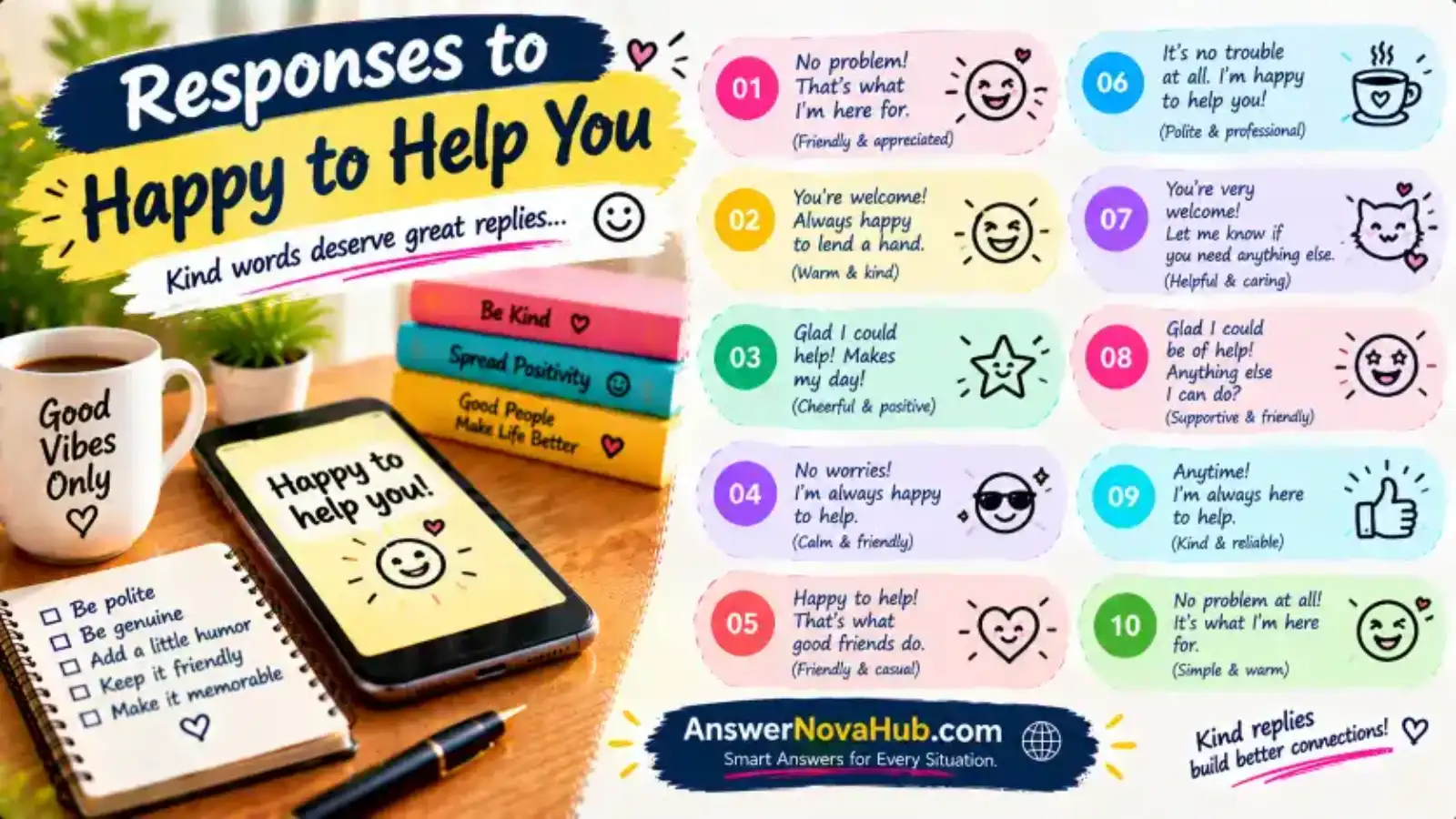
When someone says “happy to help you,” they are showing that they were willing to assist and enjoyed being useful. A simple “thank you” works, but sometimes you may want a warmer, funnier, more professional, or more thoughtful response. The right reply depends on your relationship, the situation, and the tone of the conversation.
Whether a coworker helped with a task, a friend came through for you, or someone offered support, these responses to happy to help you can help you keep the conversation natural.
Featured Snippet Answer:
The best response to “happy to help you” depends on the situation. You can say “I really appreciate it,” “Thanks again for your help,” or “I’m glad I could count on you.” For a casual conversation, try “You’re awesome!” or “And I’m happy you helped!” For work, keep your response polite and professional.
What Does “Happy to Help You” Mean?
“Happy to help you” is a friendly way of saying that someone was pleased to assist you. It usually suggests that they did not see helping as a burden.
For example:
You: “Thanks for helping me finish the report.”
Them: “Happy to help you!”
Here, they are reassuring you that they were glad to assist.
The phrase can sound:
- Friendly
- Professional
- Supportive
- Warm
- Polite
- Reassuring
Your response can match whichever tone the other person used.
Best Responses to Happy to Help You
If you want a safe and natural reply that works in most situations, try one of these:
- I really appreciate it.
- Thanks, I’m grateful for your help.
- I’m glad I could count on you.
- Thanks again for being so helpful.
- I appreciate you taking the time.
- That means a lot to me.
- You’re always so helpful.
- Thanks for having my back.
- I’m really thankful for your help.
- I couldn’t have done it without you.
- You made things much easier for me.
- I’m glad you were there to help.
- Thanks for making it so easy.
- I appreciate your support.
- You’re a lifesaver!
Polite Responses to Happy to Help You
When someone helps you in a respectful or formal setting, a polite response is usually the safest choice.
Try:
- “I really appreciate your assistance.”
- “Thank you for taking the time to help.”
- “I’m very grateful for your support.”
- “Thanks again. I truly appreciate it.”
- “Your help was greatly appreciated.”
- “Thank you for being so helpful.”
- “I appreciate your time and effort.”
- “Thanks for making this easier for me.”
These responses work well when speaking with teachers, colleagues, clients, supervisors, or other people you want to address respectfully.
Professional Responses to Happy to Help You
In a workplace conversation, your reply should be appreciative without sounding overly casual.
Good professional responses include:
- “Thank you. I really appreciate your support.”
- “Thanks for your help with this.”
- “I appreciate you taking the time.”
- “Thank you for your assistance.”
- “I’m grateful for your support.”
- “Thanks again for helping me get this sorted.”
- “I appreciate your willingness to help.”
- “Thank you for making the process much smoother.”
For email or workplace messages, “I really appreciate your help” is one of the most natural choices.
Friendly Responses to Happy to Help You
Talking to a friend? You can make your response warmer and more relaxed.
- “You’re the best!”
- “Thanks, I really appreciate you!”
- “You always come through!”
- “I knew I could count on you.”
- “You’re awesome for that!”
- “Thanks a bunch!”
- “I owe you one!”
- “You saved me today!”
- “Seriously, thank you!”
- “I’m lucky to have you!”
The best response often depends on how close you are to the person.
Short Responses to Happy to Help You
Sometimes you don’t need a long reply.
These quick responses are perfect for texts, chats, and casual conversations:
- “Thanks!”
- “I appreciate it!”
- “Thank you!”
- “You’re awesome!”
- “Much appreciated!”
- “Thanks again!”
- “You’re the best!”
- “I’m grateful!”
- “Thanks a lot!”
- “That means a lot!”
A short answer can still sound sincere when the situation does not require a detailed message.
Warm Responses to Happy to Help You
If someone went out of their way to support you, choose something more personal.
- “That really means a lot to me.”
- “I’m genuinely grateful for your help.”
- “You have no idea how much I appreciate this.”
- “It was so kind of you to help.”
- “I’m really glad you were there.”
- “Your support means more than you know.”
- “Thank you for being so thoughtful.”
- “I truly appreciate everything you did.”
These replies are especially suitable when someone helped you through a difficult or stressful situation.
Funny Responses to Happy to Help You
If you already have a playful relationship, a little humor can make your reply memorable.
- “Careful, I might start asking for help all the time!”
- “Good, because I already have another task!”
- “You just earned yourself five stars.”
- “I’ll definitely remember this heroic act.”
- “Well, that was suspiciously nice of you!”
- “You’re making it hard not to ask for more favors.”
- “And here I thought I was going to struggle alone.”
- “Congratulations, you’ve officially been promoted to my helper.”
Keep jokes appropriate to the relationship. A playful reply can work brilliantly with a friend but feel awkward in a formal workplace.
Cute Responses to Happy to Help You
For someone you are close to, you can make your response a little sweeter without overdoing it.
- “That’s why you’re one of my favorite people.”
- “You always know how to make things easier.”
- “You’re seriously too kind.”
- “I’m glad I have someone like you.”
- “You always know how to come through.”
- “You’re pretty amazing, you know that?”
- “That was really sweet of you.”
- “I appreciate you more than you know.”
How to Respond to “Happy to Help” in a Text
Text conversations usually work best with short, natural replies.
You could say:
Casual:
“Thanks! I really appreciate it.”
Friendly:
“You’re the best! Thanks again.”
Warm:
“That means a lot. Thank you!”
Funny:
“Don’t say that unless you’re ready for more requests 😂”
Professional:
“Thank you. I really appreciate your assistance.”
The key is to match the energy of the original message instead of making a simple conversation unnecessarily formal.
How to Respond to “Happy to Help” at Work
A professional response should acknowledge the person’s effort.
For example:
“Thanks again for helping me with this. I really appreciate you taking the time.”
Or:
“I appreciate your support. It made the process much easier.”
If the person helped with an ongoing project, you can also mention the specific contribution:
“Thanks for helping me organize the presentation. Your suggestions made a big difference.”
Specific appreciation often sounds more genuine than a generic “thanks.”
How to Respond When Someone Says “Always Happy to Help”
“Always happy to help” is a slightly warmer version of the phrase. You can respond with:
- “And I’m always grateful for your help.”
- “I really appreciate that.”
- “That means a lot!”
- “I’m glad I can count on you.”
- “You always make things easier.”
- “Thanks for always being there.”
- “I appreciate you more than you know.”
- “That’s very kind of you.”
How to Respond Without Saying “Thank You”
If you have already said thank you or want to avoid repeating the same phrase, try:
- “I really appreciate you.”
- “That means a lot.”
- “You made a huge difference.”
- “I’m glad I could count on you.”
- “You made my day easier.”
- “I owe you one.”
- “You came through when I needed it.”
- “I’m grateful for your support.”
These alternatives keep the conversation from sounding repetitive.
Best Responses Based on the Situation
| Situation | Natural Response |
|---|---|
| Friend helped you | “You’re the best! I really appreciate it.” |
| Coworker helped | “Thanks, I really appreciate your support.” |
| Teacher helped | “Thank you for taking the time to help me.” |
| Someone you don’t know well | “I really appreciate your help.” |
| Close friend | “I knew I could count on you!” |
| Casual text | “Thanks! You’re awesome.” |
| Professional email | “Thank you for your assistance. I really appreciate it.” |
| Someone went out of their way | “That means a lot. Thanks for going the extra mile.” |
What Should You Say When Someone Helps You?
The best response acknowledges both the help and the person who offered it.
Instead of automatically saying “thanks,” think about what happened.
If they spent only a minute helping you, a short response is enough.
If they spent an hour helping you solve a problem, a more specific message may feel more sincere:
“I really appreciate you taking the time to walk me through that. It made everything much clearer.”
That kind of response shows that you noticed their effort.
Common Mistakes When Responding to “Happy to Help”
Even a simple conversation can sound awkward if the response does not match the situation.
Being Too Formal
Saying “I extend my deepest gratitude for your assistance” to a close friend may sound unnatural.
Being Too Casual at Work
A response such as “OMG you’re a legend 😂” may not be suitable for every professional conversation.
Overexplaining
You do not always need a paragraph after someone says “happy to help.” Sometimes “I really appreciate it!” is enough.
Repeating the Same Phrase
If you have already said “thank you” several times, switch to something like “That means a lot” or “I’m glad I could count on you.”
Forgetting Their Effort
When someone has invested significant time helping you, acknowledge the effort rather than giving a generic reply.
How to Make Your Response Sound Genuine
A good response does not have to be clever. It simply needs to sound like something you would actually say.
Try adding a specific detail:
Instead of:
“Thanks for helping.”
Say:
“Thanks for helping me fix that presentation. I was completely stuck.”
The second response feels more personal because it explains why the help mattered.
Are “Happy to Help” and “Glad to Help” the Same?
They are very similar, but there can be a slight difference in tone.
“Happy to help” emphasizes willingness and friendliness.
“Glad to help” emphasizes satisfaction that the help was useful.
Both are positive expressions, and the same types of responses can generally be used for either phrase.
What Is the Best Overall Response to “Happy to Help You”?
There is no single response that fits every conversation.
For most situations, “I really appreciate it” is a strong choice because it is short, sincere, and works in both casual and professional settings.
A friend, “You’re the best!” may feel more natural.
For work, “Thank you, I really appreciate your support” is safer.
For someone who made a major effort, explain exactly what their help meant to you.
Expert Tips for Choosing the Right Reply
Think about three things before responding:
- Who helped you?
A friend, coworker, teacher, family member, or stranger may require different wording. - How much did they help?
A quick favor deserves a quick response. A major favor deserves more appreciation. - What tone are they using?
Match their tone instead of suddenly becoming overly formal or overly playful.
A natural response is usually better than the most impressive-sounding one.
FAQs:
What is the best response to “happy to help you”?
“I really appreciate it” is one of the safest and most natural responses. It works in casual conversations, professional settings, texts, and emails. If you are responding to a close friend, you can make it warmer with “You’re the best!” If the person made a major effort, mention what they specifically helped you with to make your appreciation more personal.
How do you respond to “happy to help” professionally?
A professional response could be, “Thank you. I really appreciate your support.” Other options include “Thanks for taking the time to help” or “I appreciate your assistance with this.” Keep your wording clear and respectful, especially when communicating with coworkers, clients, managers, teachers, or professional contacts.
Can I say “I appreciate it” after someone says “happy to help”?
Yes. “I appreciate it” is a natural response because it directly acknowledges the person’s willingness to help. You can make it slightly warmer by saying, “I really appreciate it” or “I really appreciate your help.” Both work well in everyday conversations and professional communication.
What is a friendly reply to “happy to help”?
A friendly reply could be “You’re the best!” or “Thanks, I really appreciate you!” You can also say “I knew I could count on you” if the person is someone you know well. For a casual text, keeping the response short often sounds more natural than writing a long message.
How do you respond to “always happy to help”?
You can say, “And I’m always grateful for your help,” “That means a lot,” or “I’m glad I can count on you.” If you are speaking to a close friend, “You always come through!” sounds warm and natural. Choose the response based on how close you are and how much help they provided.
How do you respond to “happy to help” in an email?
A professional email response can be simple: “Thank you for your help. I really appreciate you taking the time to assist me.” If their help solved a particular problem, mention it specifically. For example, “Your guidance helped me resolve the issue quickly” sounds more thoughtful than repeating “thank you” several times.
What can I say instead of “thank you” after someone helps me?
You can say “I really appreciate it,” “That means a lot,” “I’m grateful for your support,” “You made things much easier,” or “I’m glad I could count on you.” These alternatives are useful when you want to avoid repeating “thank you” while still showing genuine appreciation.
What is a funny response to “happy to help”?
If the conversation is casual, try “Careful, I might start asking for help all the time!” or “Good, because I already have another task!” You can also say, “You just earned yourself five stars.” Make sure the humor fits the relationship, especially when responding to someone you do not know well.
Conclusion:
The best responses to happy to help you are the ones that match the relationship and situation. A simple “I really appreciate it” works almost anywhere, while friends may prefer something playful like “You’re the best!” and professional contacts may call for a more polished response.
When someone takes the time to help you, a specific and sincere acknowledgment usually makes the conversation feel more genuine.
Choose your wording based on the person’s effort, your relationship, and the tone of the conversation.

I’m Alexander Hayes, and I enjoy helping people communicate with confidence by finding the right response for every situation. I create well-researched, practical, and easy-to-follow reply guides that make conversations more natural and meaningful. My goal is to provide reliable advice and thoughtful responses that readers can use with confidence every day.